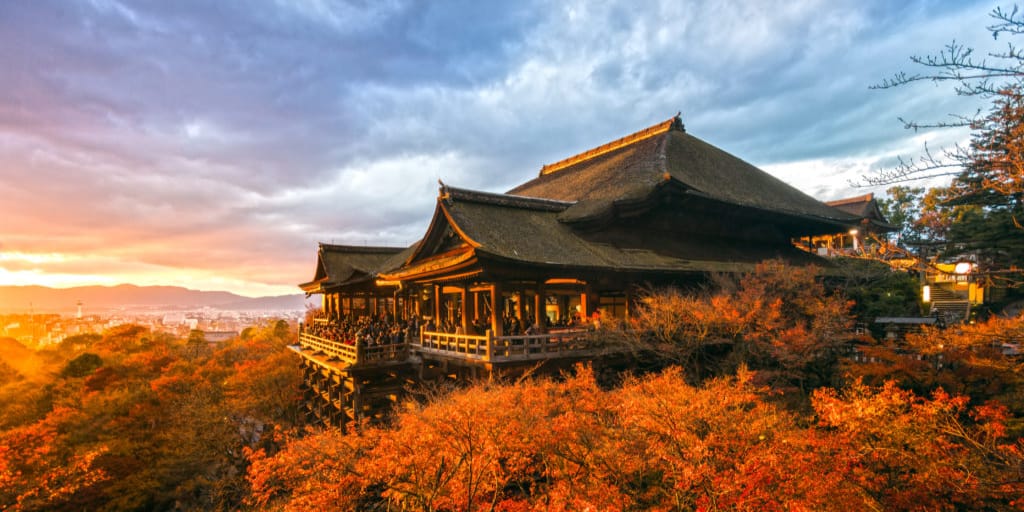
How Much Does an Osaka + Kyoto Summer Trip Actually Cost for a Group in 2026
Updated March 2026 · Based on current pricing and group spending data
Your group chat fills up with flight options before anyone asks the real question: how much will this actually cost? For six friends splitting a summer trip between Osaka and Kyoto—three nights in each city—you're looking at $1,200 to $1,930 per person for a budget or balanced trip, or $3,480+ for premium ryokan luxury. The yen is weak right now, which helps. The heat in Kyoto in July is brutal, which doesn't. And the temple fees add up faster than you'd think.
Japan has specific friction for Western visitors that most guides gloss over: you'll need cash at temples and small restaurants, you'll buy an IC card you don't quite understand, and you'll discover that Kyoto's culture comes with an entry fee. This guide walks you through the actual numbers and flags where first-time visitors get surprised.
The short version:
A 6-night Osaka + Kyoto trip for a group of 6 costs roughly $1,200 to $3,480 per person, including flights from US West Coast, accommodation split six ways, food, local transit, temple entry fees, and extras.
- Budget: ~$1,200
- Balanced: ~$1,930
- Premium: ~$3,480
The full cost breakdown
| Category | Budget | Balanced | Premium |
|---|---|---|---|
| Flights (round-trip, per person) | $815 | $1,050 | $1,600 |
| Accommodation (per person, 6 nights) | $150 | $420 | $1,050 |
| Food & drinks (per person, 6 days) | $96 | $222 | $510 |
| Getting around (includes KIX airport transfer) | $58 | $64 | $76 |
| Admission & activities (temples, attractions) | $18 | $37 | $60 |
| Fees & extras (insurance, SIM, supplies, exit tax) | $60 | $138 | $183 |
| Total per person | ~$1,200 | ~$1,930 | ~$3,480 |
Accommodation splits shared costs by 6 people. West Coast flight pricing; East Coast flights run $300–400 higher. Flights assume US West Coast departure. Budget reflects deal economy fares with connections; balanced includes direct flights or flexible booking; premium includes premium economy or business class. Use the calculator to adjust for your departure city.
Flights: Why West Coast matters
Round-trip to Osaka Kansai International Airport from the US West Coast runs $680–$950 right now. East Coast flights are $300–400 more ($1,000–$1,300 range). The gap isn't really about distance—it's about routing. Osaka has fewer direct flights than Tokyo, so West Coast flyers tend to get better connections and cheaper fares. You can compare current routes and fares on Kayak's KIX flight page.
Book two months out if you can. July and August are peak season but not cherry blossom peak, so prices are reasonable compared to spring. Tuesday-to-Friday flights are consistently $100–$150 cheaper than Friday-to-Monday.
If your group is scattered—some from LA, some from Boston—reconcile the price difference early: whoever pays more can ask the cheaper flyer to cover something in Japan.
Accommodation: The two-city math
This is where group size actually saves you money, and where the split between Osaka and Kyoto changes the numbers.
Osaka (3 nights): Budget hotels and business hotels run $40–$80 per room per night. For six people, you need three rooms. Capsule hotels are $20–$30 per bed, business hotels $60–$90 per room ($30–$45 per person in a double).
Kyoto (3 nights): Two paths. Standard balanced hotel ($70–$100 per person, similar tier to Osaka). Or a ryokan (traditional inn) at $80–$110 per person that includes dinner and breakfast, cutting your food budget by ~$20 per day.
Budget calculation (balanced, group of 6):
- Osaka: $70/person/night x 3 nights = $210
- Kyoto: $70/person/night x 3 nights = $210
- Total: $420 per person (6 nights)
Book Kyoto accommodation early. Late July books up—Gion Matsuri (July 1–31) draws crowds and drives up prices.
Food & drink: Osaka street food vs. Kyoto culture
Osaka is about eating constantly and cheaply. Dotonbori is neon signs and crowds and takoyaki (octopus balls) at every corner ($4–$6). Okonomiyaki runs $8–$11 for a full meal. Kuromon Market has stall food for $20–$27 for lunch. Convenience stores (7-Eleven, FamilyMart, Lawson) have onigiri for ¥150, karaage for ¥250. You can eat three meals a day for $15–$20 in Osaka.
Budget Osaka: $15–$20/day. Balanced: $30–$40/day. Premium: $70–$80/day.
Kyoto is kaiseki (haute cuisine) and matcha culture. Budget kaiseki lunch is $40–$67. Balanced dinner is $67–$100. Premium kaiseki is $165+. Nishiki Market lunch runs $20–$33.
The trick: a balanced ryokan includes dinner and breakfast, saving roughly $20/day in food costs for the three Kyoto nights.
Budget Kyoto: $15–$20/day. Balanced: $35–$45/day. Premium: $80–$100/day.
The reality: no one visits Japan and eats like they plan. Budget another $10–$20 per person for food impulses.
Getting there & getting around
KIX Airport to Osaka: Nankai Rapi:t Express is the move—¥1,490 (~$10), 34 minutes to Namba Station. JR Haruka is $17 per person and slower. For a group, Nankai Rapi:t hits the sweet spot.
Local Transit in Osaka (3 nights): Buy an IC card (ICOCA) when you land. Cost: ¥2,000 (~$13) including ¥1,500 usable balance (¥500 is a refundable deposit). Metro is ¥220–¥350 per trip. Budget $25–$40 for three nights per person.
Osaka to Kyoto: JR Special Rapid costs ¥580 (~$3.60) and takes about 30 minutes.
Local Transit in Kyoto (3 nights): Temples aren't on the subway. You'll need buses. Buy a Kyoto Subway & Bus 1-Day Pass (¥1,100, ~$7.50) for temple-hopping days. Budget $15–$30 per person.
Total transit (Osaka + Kyoto + transfer): $40–$60 per person for the entire trip.
Temples, shrines & the accumulation problem
Kyoto has 1,000+ temples. Your group will probably visit 10–15. Each temple entry is roughly ¥500 (~$3.35). Sounds fine. Until you've paid it eight times in two days and you're $27 deeper than you budgeted.
Budget itinerary (5–7 temples): Kiyomizu-dera (¥500), Kodai-ji (¥600), Fushimi Inari (free), Arashiyama bamboo groves (free). Total: $15–$25.
Balanced itinerary (10–12 temples): Above plus Kinkaku-ji (¥500), Arashiyama temples (¥400–¥600 each). Total: $30–$45.
Premium itinerary (15+ temples): All of above plus Philosopher's Path temples, extended Arashiyama. Total: $50–$70.
What guidebooks miss: optional donations (¥100–¥500), souvenir charms/omamori (¥500–¥1,500 each, cash only), matcha tea at temple cafes (¥800–¥1,200, often cash-only). A ¥500 entry can become ¥2,000–¥3,000 per person. For a full list of entry fees, see Japan Guide's Kyoto temples page.
Many shrines throughout Kyoto are free. Hit the famous paid temples and fill time with free shrines and walking neighborhoods (Gion, Higashiyama).
Hidden and unexpected Japan costs
Cash is still king. Japan is 50/50 cash/card in 2026. Temples, small restaurants, street food, and local shops often take cash only. Use a 7-Eleven ATM (they accept foreign cards). Plan to withdraw ¥20,000–¥30,000 ($125–$190) upfront.
Language barriers are real in Kyoto. Tokyo has English signage everywhere. Kyoto has it in tourist zones but sparse in neighborhoods. A translation app is free, but a paid Kyoto guidebook app ($5–$15) helps.
Temple donations and souvenirs add up quietly. Budget $50+ per person for souvenirs and donations if you're doing temples seriously.
Summer heat in Kyoto affects your itinerary. July-August averages 30–35°C (86–95°F) with 82% humidity. Budget an extra ¥500–¥1,000 per day ($3–$7) for heat-related comfort spending.
Airport exit tax is mandatory. Starting July 2026, Japan's departure tax rises to ¥3,000 per person (~$20), up from the previous ¥1,000. It's automatically included in your airline ticket.
Weak yen advantage is real right now. The yen is at ¥160 per USD (March 2026), the weakest in a decade. Your dollars stretch 10–15% further than two years ago.
How the three tiers actually feel
| Budget | Balanced | Premium | |
|---|---|---|---|
| Sleep | Business hotel (Osaka), hostel or budget hotel (Kyoto) | Business hotel (Osaka), balanced ryokan with meals (Kyoto) | 4–5 star hotel or luxury ryokan (both cities) |
| Eat | Dotonbori street food, konbini, Nishiki casual | Mix of restaurants, one or two kaiseki dinners, Kuromon lunch | Multiple kaiseki meals, upscale restaurants, matcha experiences |
| Do | Fushimi Inari (free), Arashiyama walk (free), 5–7 paid temples | 10–12 temples including major ones, light food tours | 15+ temples, extended cultural experiences, specialized tours |
| Get around | IC card, metro only | IC card, day passes, occasional taxi | Taxis default, IC card as backup |
| Per person | ~$1,200 | ~$1,930 | ~$3,480 |
The real dividing line isn't accommodation price. It's food and activity tier. A budget group will splurge on one nice dinner and it becomes balanced. A balanced group will book an extra cultural tour and it becomes premium.
How groups keep it together
Designate one person to book shared expenses and track everything. The person who books the Osaka hotel, whoever pays for that group dinner. Use a shared expense tracker to log each expense real-time. Settle every two days so nobody's carrying a balance.
Separate cash spending from card spending. Temple fees, street food, konbini, donations—these are all cash. Keep cash receipts. Phone-photograph them.
Book accommodations together. Decide on tier before anyone books. One person books Osaka, one books Kyoto, or one person books both. Collect deposits that day. Good places book up two months out.
Clarify temple/activity days in advance. If half your group wants to temple hop and the other half wants to shop, split the group on temple days.
The weak yen is your buffer. Costs are lower than they'd be in any other recent year for USD travelers. Build that advantage into your planning instead of spending it.
The bottom line
A group of six can do six nights in Osaka and Kyoto for $1,200 to $3,480 per person depending on how you structure accommodation and what you do. The weak yen helps. The logistics (cash culture, IC cards, temple fees) are easier once you know they're coming. Summer heat is brutal in Kyoto but short.
The group chat will book flights before anyone really wants to commit. Then someone will ask "okay but for real, how much is this." Now you have the number.
Traveling with a group? Check out our cost guides for other popular Asian destinations: Tokyo cherry blossom trip cost guide and Shanghai summer group trip cost.
Planning your own Japan trip?
Start a YAAT group and track shared expenses—from the ryokan booking to the temple entry fee split.