How Much Does Seoul Summer Really Cost for a Group in 2026
Real cost breakdown for Seoul summer trips 2026 — budget, balanced, and premium options for groups of 6.
Cost calculator
Estimated per-person cost for a group of 6 (5 nights, West Coast flight, Balanced accommodation & food, Moderate activities)
| Category | Per person |
|---|---|
| Flights (West Coast) | $650 |
| Accommodation (Balanced, 5 nights, split 6 ways) | $125 |
| Food & drink (Balanced, 5 days) | $210 |
| Activities (Moderate) | $80 |
| Transportation | $19 |
| Fees & extras | $80 |
| Total per person | $1,164 |
| Group total (6 people) | $6,984 |
Based on current Seoul pricing for summer 2026. Won conversions at approximately 1,450 KRW = $1 USD.
Use the interactive calculator above to adjust for your group size and preferences.
A five-night group trip to Seoul for six friends in July or August costs roughly $937 to $1,990 per person, depending on how you sleep, eat, and whether someone insists on the Korean BBQ experience (they will). The flights are the anchor. Everything else stacks on top—and everything is cheaper than the last group that flew here thinking the ticket was the main cost.
If you've never been to Seoul, there are specific things that catch first-timers off guard. Korean BBQ is one of the most common splurge-ish social meals groups plan around. Tipping is generally not expected in Korea, which keeps restaurant spend lower than many U.S. travelers are used to. The airport transfer is straightforward but only if someone explains it first.
The short version:
Assumes 6 travelers, 5 nights, July–August, US West Coast origin, shared rooms, and moderate activities.
Budget: ~$937/person | Balanced: ~$1,162/person | Premium: ~$1,990/person
Budget = hostel beds, street food, selective transit. Balanced = comfort-focused but cost-aware: shared hotel rooms, restaurant meals, unlimited transit. Premium = higher-comfort with taxis, nicer dining, and 4-star hotels — but not luxury.
- Budget: ~$937/person
- Balanced: ~$1,162/person
- Premium: ~$1,990/person
The full cost breakdown
| Category | Budget | Balanced | Premium |
|---|---|---|---|
| Flights — round-trip airfare per person from US West Coast, booked 1–3 months out | $600 | $650 | $900 |
| Accommodation — per-person nightly cost assuming shared rooms, × 5 nights | $25 | $25 | $65 |
| Food & drink — per-person daily spend, × 5 days | $16 | $42 | $95 |
| Activities — per-person total across the trip, not per day | $55 | $80 | $120 |
| Transportation — airport round trip + local transit for 5 days | $22 | $17 | $50 |
| Fees & extras — SIM/eSIM, insurance, cash buffer, minor sightseeing | $55 | $80 | $120 |
| Total per person | $937 | $1,162 | $1,990 |
Budget transport is higher than balanced because individual T-money rides cost more over 5 days than the unlimited Climate Card pass included in balanced. Totals are derived from the scenario assumptions above and may differ from market averages. Example: Balanced = $650 + ($25 × 5) + ($42 × 5) + $80 + $17 + $80 = $1,162.
Flights: The Starting Point
Round-trip flights from the US West Coast (LAX, SFO, SEA) to Seoul run $600–$700 in budget, $650–$750 for balanced, and $900–$1,100 for premium. East Coast flights add $100–$200. Booking earlier usually helps, but airfare is volatile enough that exact savings depend heavily on route and season. Midweek departures are often cheaper than peak weekend departures, but the difference can vary widely. These flight ranges are planning baselines, not guaranteed fares. The $600 budget floor assumes flexible dates and advance booking; peak July–August fares may start closer to $650–$700.
For a group of six, someone will want to leave at different times. Reconcile this early. The person flying from Denver and the person from Boston don't need to match itineraries, but pretending the price difference doesn't exist causes friction later.
Accommodation: The Anchor Cost
You can sometimes find budget-friendly central Seoul rooms in the $50–$85 range, but actual summer hotel pricing varies a lot by neighborhood, timing, and availability. Using two low-cost rooms for six people works out to about $25 per person per night in this model. If your group wants larger rooms, en-suite certainty, or more central locations, lodging can move up fast. Hostels are $25 per dorm bed.
Budget groups book hostels. Balanced groups book multiple hotel rooms or a guesthouse. Premium groups book 4-star properties at $120–$300 per room ($65/person/night).
Hanoks (traditional Korean houses) run $60–$300 per night. Balanced hanoks run $80–$120/night. The experience is genuine—sleeping on a floor mat, communal courtyard—but it's not cheaper than hotels. Book for the experience, not the savings.
Food & Drink: The Variable
Street food costs $3–$6 per meal. Convenience store meals run $1–$3. Casual restaurants $6–$9. Korean BBQ (samgyeopsal) is pork belly cooked on a table grill, $26–$37 per person at a balanced spot, $44–$74 premium (Hanwoo wagyu).
Korean BBQ is the signature meal. Budget one or two dinners minimum. It's already in the balanced food estimate.
Balanced daily eating runs $35–$50/day. Premium eating is $70–$120/day. Most restaurants take cards. Street food vendors often prefer cash—having ₩200,000–300,000 (~$140–$210) on hand is a comfortable buffer for street food specifically.
Transportation: Getting There and Getting Around
Airport to hotel: The AREX All-Stop train takes about 60 minutes to Seoul Station for ₩4,750 ($3.25) one-way, or take the nonstop AREX Express in 43 minutes for ₩13,000 ($9) one-way; fares vary by channel and current pricing, so verify before purchase.
Getting around Seoul: The 5-day Climate Card is ₩15,000 (~$10) for unlimited metro and bus. As of March 2026, foreign credit and debit cards are accepted at subway ticket machines for Climate Cards and single-ride tickets. At around 3–4 rides per day, the 5-day Climate Card pays for itself compared to per-ride fares.
Combined: AREX All-Stop round-trip (~$6.50) + Climate Card ($10) = ~$17 per person (balanced). Premium adds occasional taxis = $50 per person. For most cost-conscious groups, the all-stop train plus Climate Card is the default value option.
Fees, Extras & First-Timer Friction Points
K-ETA: U.S. citizens are temporarily exempt through Dec. 31, 2026; always confirm current entry requirements before departure. Airline and immigration forms can change, so check official entry guidance close to departure.
SIM Card or eSIM: $4–$15 per person. Buy an eSIM online before you leave.
Travel Insurance: Optional but common; cost depends on age, coverage, and provider. Budget $30–$50 per person.
Currency: Withdraw cash at an ATM in Myeongdong (best exchange rates). ₩300,000–₩400,000 (~$210–$275) is a comfortable total cash buffer covering street food, transit top-ups, and small purchases; top up as needed.
Tipping: Generally not expected in Korea, which keeps restaurant spend lower than many U.S. travelers are used to.
Karaoke (noraebang): ₩5,000–₩17,000 per person for 30 minutes ($3.50–$12). Namsan Tower is ₩29,000 ($19–$20), Gyeongbokgung Palace is ₩3,000 ($2).
Total Fees & Extras: $55–$120 per person depending on tier.
Korean BBQ: The Signature Meal
Korean BBQ is one of the most common splurge-ish social meals groups plan around. Table-top grilling, you cook it yourself, it's social, it's iconic. At balanced restaurants it's $26–$37 per person with drinks. Budget groups can do it once. Balanced groups 1–2 times. Premium groups at a Hanwoo restaurant for $44–$74.
Order pork belly (samgyeopsal, $8–$10 per 150g serving). You get side dishes automatically. Everyone eats from the same grill.
First-timer tip: Myeongdong tends to be more tourist-oriented, so groups looking for better value often compare it with Hongdae or Gangnam.
Han River Parks: The Summer Move
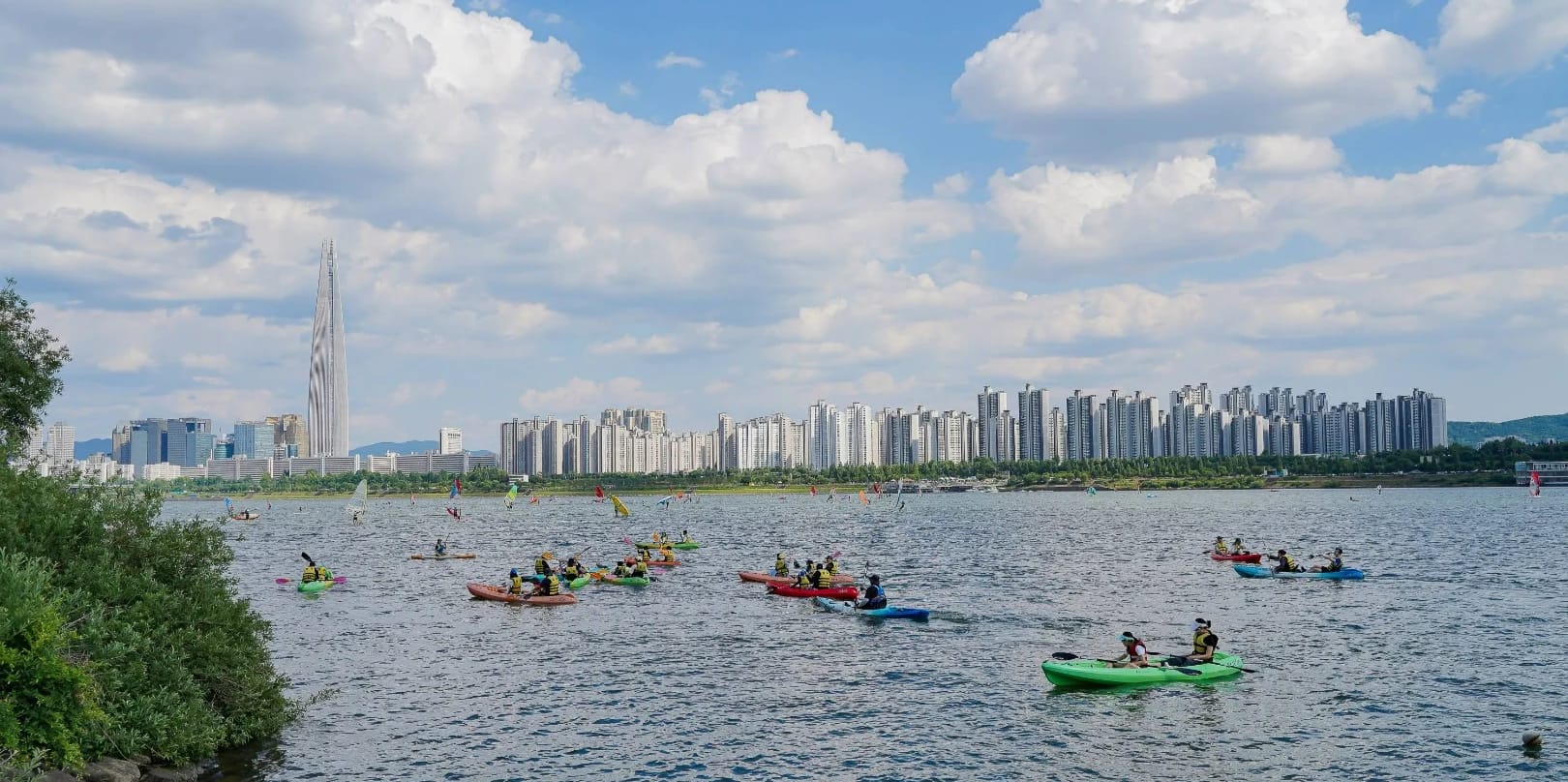
Yeouido and Banpo Hangang Parks are where Seoul's summer happens. Free to enter. A convenience store picnic runs ₩10,000–₩15,000 (~$7–$10) per person. The Banpo Rainbow Bridge Fountain runs April through October, free to watch.
Ttareungi (public bikes) costs ₩1,000 ($0.70) per hour. Swimming pools at Ttukseom and Yeouido charge ₩5,000 ($3.50) entry during summer.
Nearby: Bukchon Hanok Village (free to walk through). Gwangjang Market for bindaetteok (₩5,000/$3.50) and mayak gimbap (₩3,000/$2).
How the three tiers actually feel
| Budget | Balanced | Premium | |
|---|---|---|---|
| Sleep | Dorm bed in Hongdae hostel ($25/night) | 3-star hotel or guesthouse ($25/person/night) | 4-star hotel ($65/person/night) |
| Eat | Street food, convenience stores (~$16/day in model) | One restaurant meal, street food, one Korean BBQ ($35–$50/day) | Restaurant meals, multiple Korean BBQ, premium cafes ($70–$120/day) |
| Drink | Convenience store soju ($3–$5) | 1–2 cocktails/night, one night out ($40–$60/trip) | Cocktails, wine, 2–3 nights out ($100+/trip) |
| Move | AREX All-Stop + T-money selective (~$22) | AREX All-Stop + Climate Card (~$17) | AREX + Climate Card + taxis ($50) |
All tiers include activities: Light ($55), Moderate ($80), or Full ($120) per person.
How groups keep it together
One person books, everyone reimburses day-one. The person who books the hotel gets everyone's share before the trip, not after.
Get the T-money card on day one together. Go as a group, buy six Climate Cards, hand them out.
Split food differently than accommodation. Whoever pays for a meal logs it (with a receipt photo), everyone settles what they actually ate. Accommodation is shared equally.
Set a group kitty for small things. $20 per person at the start ($120 total). Anytime anyone buys a shared item, pull from the kitty.
The bottom line
The price you see above is real. The rest is logistics.
Before you book flights, get everyone on the same page about budget tier. The difference between street food and restaurant meals, or between hostels and hotels, is the entire cost variance. Agree on tier, then the numbers stick.
Planning your own Seoul group trip?
Track expenses as you go with an expense-sharing app. We handle the cost planning so you don't have to.